Phoenix Trader Funding Review 2026: Rules & Payout Risks
Phoenix sells futures evaluations with four different routes: Classic, Daily, Spark and Merit. The key buying decision is not the advertised account balance. It is which payout restrictions, review process and later costs you can accept.
Classic offers the clearest starting point for comparing Phoenix rules: a 90% split, five qualifying winning days and capped weekly payouts. Daily offers more frequent requests at an 80% split, but matured profit is not protected cash. Merit is discretionary selection, not a guaranteed pass. A documented account-closure complaint and conflicting public details warrant caution before buying any route.
Key takeaways
- Simulation first: a funded label is not proof of live market execution, nor is the nominal account balance money you can withdraw.
- Different payout mechanics: Classic has buffers and request caps; Daily adds maturation and daily caps; Spark has a separate cadence; Merit depends on human approval.
- Look beyond the entry fee: monthly renewals, activation, resets, data and connection costs vary by product.
- Mixed community evidence: positive payout reports coexist with a detailed closure/live-transition dispute. Neither reviews nor company replies are an audit.
- No hands-on performance claim: this is a source-led review. The only FundingCodes transaction evidence cited is a separate, dated, no-purchase coupon test.
How we reviewed Phoenix
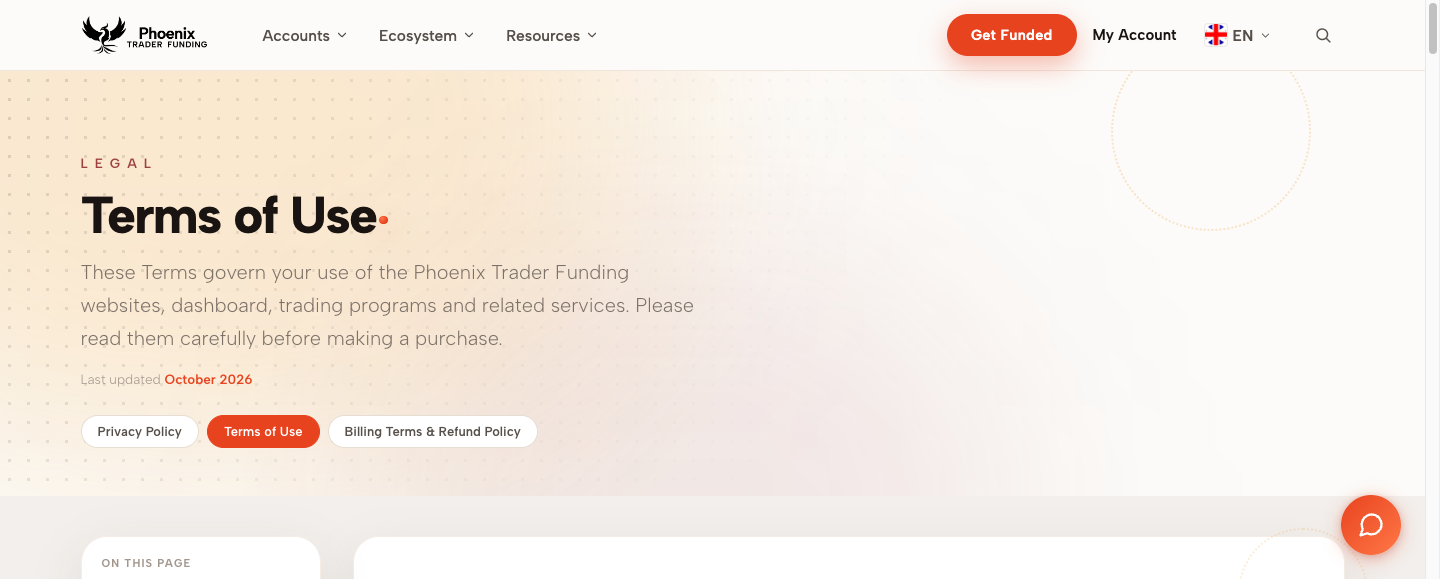
We checked Phoenix’s public account pages, payout help article, October 2026 legal terms and live Trustpilot profile on October 23, 2026. We did not purchase or trade an account, test execution or copier connections, contact support for this review, or receive a payout. Screenshots show public pages, not our trading results.
Affiliate disclosure: FundingCodes is an approved Phoenix referral partner and may earn a commission from qualifying purchases through its links. That does not make our issued code the best available deal. See our editorial policy and the separately dated Phoenix Trader Funding coupon test.
What is Phoenix Trader Funding, and is it legit?
Phoenix’s October 2026 terms identify the operator as Phoenix Trader Funding SAS, registered in Paris under RCS 978 715 332, with Léon Grimm as président. These are the merchant’s legal disclosures, not our independent company-registry verification.
The terms say Phoenix is not a broker, does not hold client money and sells simulated trading evaluations. Funded accounts are also described as simulated, with live or copied accounts offered separately at its discretion. Profit shares are paid from Phoenix’s own resources, mainly program fees. That creates a firm-payment risk distinct from a personal brokerage account holding your cash.
A disclosed legal entity and customer payout reports support further due diligence; they do not establish solvency, regulatory protection or guaranteed future payments. We have not independently verified an AMF authorization or any other regulatory status. Do not treat a merchant accreditation statement as a regulator-confirmed endorsement.
Classic vs Daily vs Spark vs Merit: which rules are different?
Choose the account family before comparing price. A discount does not remove payout conditions or turn a simulated balance into live capital.
| Route | Published entry terms | Main tradeoff |
|---|---|---|
| Classic | Monthly evaluation; no activation fee; two-day minimum and 50% evaluation consistency. | 90% split, five qualifying winning days between payouts, locked buffer and request caps; no funded consistency rule. |
| Daily | One-time account cards; no activation fee; two-day evaluation minimum and 50% consistency. | 80% split, Security Threshold, three-trading-day maturation normally, five for big days, and daily payout caps. |
| Spark | Landing page advertises entry from $44 once plus $29 activation; one-day pass possible with no evaluation consistency rule. | 90% split; 30% funded consistency; first request after five qualifying winning days, then advertised bi-weekly requests. Funded drawdown trails in real time. |
| Merit | $69 one-time advertised; no activation fee or profit target; static drawdown. | A 30-calendar-day assessment with human selection, not an entitlement to funding. No reset; the displayed card also lists 25% dynamic daily drawdown. |
Sources: the official Classic, Daily, Spark and Merit pages. These are public descriptions, not checkout-tested offers. Confirm the account version and funded agreement before payment.
What does Phoenix cost beyond the headline price?
Classic Starter $25K displayed $89 per month before promotion in our October 19 coupon test. Spark advertises a lower entry fee but a separate $29 activation charge. Merit advertises $69 once. Daily’s page illustrates why a headline price is not a final quote: its prose says $59/$119/$199, while the hydrated cards on October 23 showed $59.40/$119.40/$197.40 promotional totals for 10K/25K/50K. We did not test those Daily carts or establish tax treatment.
The billing terms say subscriptions renew monthly on the original purchase date until cancelled. Cancel through the dashboard or by email before renewal; cancellation does not refund the current period. A cancelled subscription cannot be reactivated without a new purchase.
Additional connections and Level II data are sold for one month. A reset does not extend the agreed evaluation period. Fees are generally non-refundable after delivery, with stated exceptions for billing errors, non-delivery, unauthorized payments and applicable legal rights. Save the checkout’s billing type, renewal amount and applicable terms rather than assuming a promotion lasts indefinitely.
Coupon evidence, dated October 19: our issued Vv1pCBp reduced one monthly-billed Classic Starter $25K/TFeed cart, without optional add-ons, from $89.00 to $84.55 before tax. Public HALLOWEEN30 returned $62.30 when applied separately. No payment was submitted. Other products, stacking, activation/reset discounts and future renewals remain unverified. The Phoenix discount code page preserves the exact scope and limitations; this review does not refresh that checkout date.
How do Classic drawdown and payouts work?
Classic’s end-of-day trailing loss limit is different from the nominal account size. The current Classic payout article says the drawdown stops trailing at the starting balance; at the first withdrawal it is set to that balance if it has not already reached it, then remains static.
| Classic size | Qualifying profit per winning day | Locked buffer | Maximum per payout |
|---|---|---|---|
| Starter $25K | $100 | $1,500 | $600 |
| Growth $50K | $200 | $2,000 | $1,000 |
| Scale $100K | $300 | $3,000 | $2,000 |
The article lists five days to the first payout and five between later requests, a $75 minimum, weekly frequency and a 90% split for all three sizes. The Classic page specifies five winning days at the thresholds above. A request cap is not a promised payment, and a buffer is not withdrawable cash.
Classic advertises no daily drawdown, no minimum trade duration and Tier 1 news trading. Those freedoms do not remove the overall loss floor, position limits or prohibited-practice rules. Its evaluation has a 50% consistency rule; the funded stage has none.
Live transition needs confirmation: the payout article says four payouts lead to EdgeClear live funding, listing $1,250/$2,000/$3,500 for Starter/Growth/Scale with static drawdown. The Classic landing page adds Phoenix-team approval, while the general terms preserve discretion. Do not read “four payouts” as an unconditional guarantee of a live account.
Does Phoenix Daily really pay out every day?
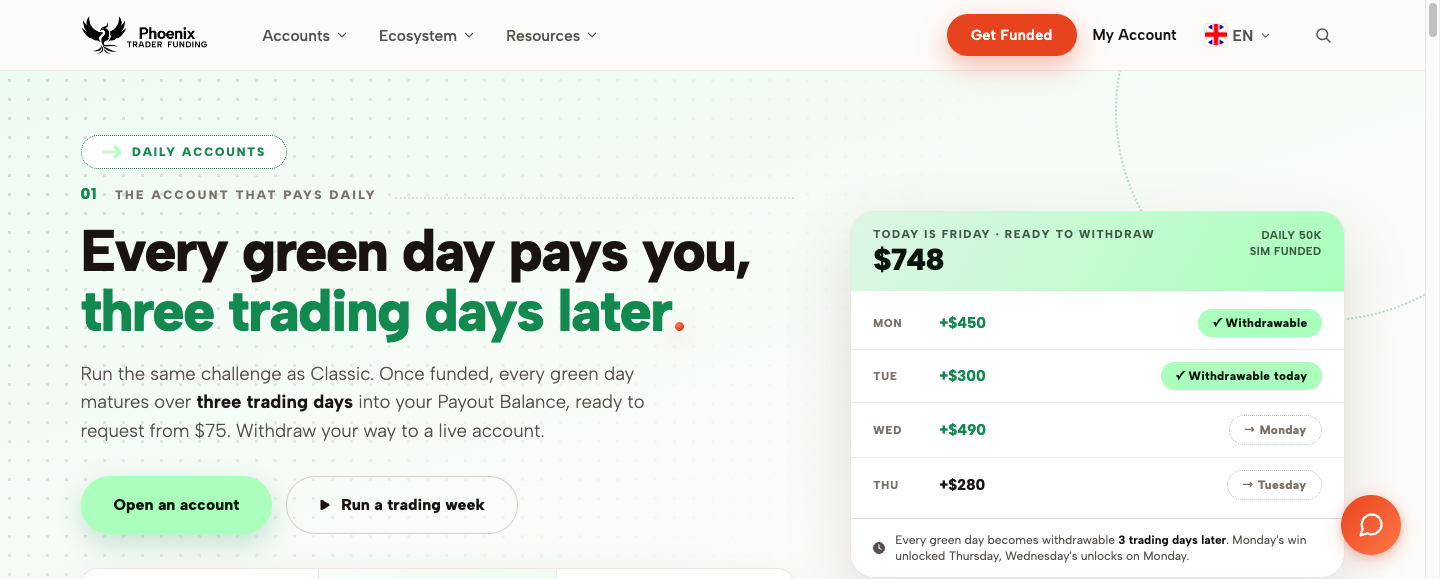
Daily allows requests as eligible profits mature, not instant withdrawal of every green day. Its published mechanics require building the Security Threshold at half size first: $600/$1,500/$2,000 for 10K/25K/50K. Above it, ordinary green days mature over three trading days; days exceeding 30% of total profit take five closes.
The maturation clock advances only when the account trades. Losing days trim the newest maturing profit first. Daily caps are $200/$500/$1,000 respectively, the minimum request is $75 and the split is 80/20. The Payout Balance is not a protected wallet: a drawdown breach forfeits all profit still in the account, including matured but unwithdrawn profit.
The route to live uses cumulative cash received—your 80% share—not gross simulated profits. The page lists $1,200/$3,000/$6,000 in withdrawals before transition and $500/$1,250/$2,000 in live funding, with static drawdown. Account approval and the governing agreement still matter.
Daily advertises under-24-hour delivery of approved payouts with a conditional doubling promise. The general terms instead say approved payouts are normally sent within three business days. We have not tested either timing or the promotion’s remedy; ask which rule governs your account and distinguish request eligibility, approval and receipt.
What changes when Spark becomes funded?
Spark has no evaluation consistency rule, but its current payout help article lists 30% funded-stage consistency. The drawdown also changes from end-of-day during evaluation to real-time trailing once funded. In both stages it stops at the starting balance; the first withdrawal sets it there if it has not already reached it.
For Seed $10K and Starter $25K respectively, the help table lists qualifying daily profit of $40/$100, minimum payouts of $30/$75 and maximums of $300/$400 per request, with no buffer and a 90% split. The landing page describes five winning days before the first request, then bi-weekly requests; the help table also labels frequency “Bi-Weekly.” Confirm how later qualifying days and the payout window combine for your account rather than assuming every fifth trading day guarantees payment.
The help article says Spark Growth $50K is closed to new purchases and existing holders retain their purchased terms. Its four-payout live route must still be read with the landing page’s team-approval condition and the general agreement—not as unconditional funding.
Why Merit is not an easy-pass alternative
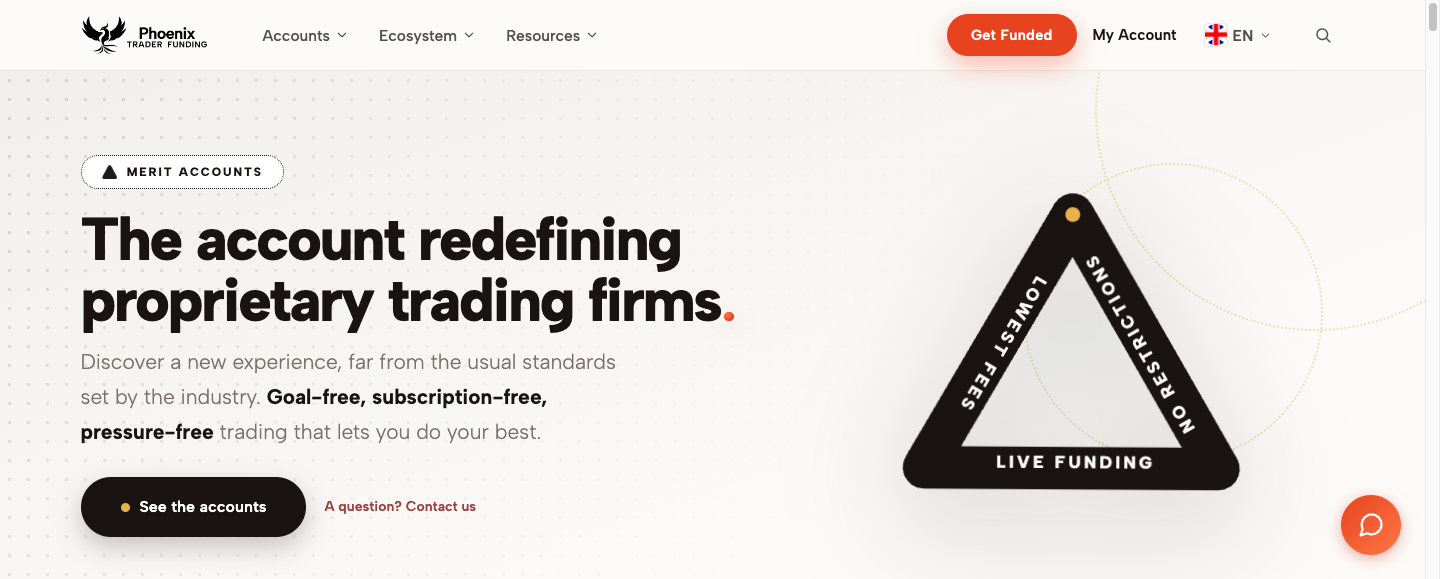
Merit removes the fixed profit target, not the selection risk. Phoenix says a risk team and AI analyze the account over 30 calendar days and a human decides whether to offer live funding. A profitable result does not guarantee acceptance.
The page lists static drawdown, no overnight or weekend holding and no resets. Its account card also shows a 25% dynamic daily drawdown, despite broad “almost no rules” marketing. Confirm how that percentage is calculated and enforced. The card’s minimum-calendar-day field differs from the 30-day narrative; do not assume an early pass.
Merit is TFeed-only at evaluation. The live-transition article says KYC comes first and describes an EdgeClear live account using Rithmic, with transfers taking one to ten business days. That is the merchant’s process description, not our tested onboarding experience.
Platforms, country eligibility and prohibited strategies
Phoenix promotes Odin, TFeed, Thor and Saga. Its Spark page describes TFeed connections involving Tradovate, Rithmic, TradingView, dxFeed and NinjaTrader, including NinjaTrader simulation accounts. This is not proof that every combination is a native Phoenix brokerage connection or free with every plan. Check the connection guide, exact feed, software licensing, data and copier permissions for your account. We did not test any integration.
The terms require age 18 or the higher local age of majority, one personal customer profile and KYC before funded activation and profit-share payment. The country page lists restricted residences, including Turkey, Egypt and Russia, plus territory-specific restrictions elsewhere. The United States is not on that displayed exclusion list; that alone does not guarantee any individual’s eligibility or later broker onboarding.
Even where a product says “all strategies allowed,” the general terms prohibit cross-account hedging, account rolling/cross-account martingale, third-party account management, exploiting feed errors and using other identities to evade limits. Check news, overnight holding, automation and contract limits for the exact product and stage rather than carrying one plan’s permission into another.
What Trustpilot and Reddit do—and do not—prove
The live Trustpilot profile showed 4.5/5 from 259 reviews on October 23, 2026. This is Trustpilot’s dated score, not our rating or a verified payout success rate.
- Positive reports: an October 15 reviewer praised payout speed; an October 20 reviewer praised support availability. We did not verify their account or payment records.
- Delay report: a September 30 review said a first payout took nine days of review but was ultimately paid. It is an individual account, not a measured average.
- Material dispute: in an October 2 review and company response, a trader alleged closure after two payouts and months without a resolved live transition. Phoenix confirmed closure and the two payouts, said it could not establish whether cheating occurred, acknowledged poor communication and said it changed rules and live onboarding. The reply referred to a discontinued Spark $50K program. We cannot adjudicate the case or assume the changes eliminated the risk.
That dispute is a reason to seek written clarity on account closure, payout review and live-transition criteria—not to label every payout report false or declare the firm risk-free. Save the version of the terms attached to your purchase.
Our targeted Reddit search produced little substantive Phoenix-specific material. One retrieved r/Forex thread had a deleted original post when opened. We did not establish a usable Reddit consensus and do not treat the search snippet as verified customer experience.
Who should consider Phoenix—and who should compare alternatives?
Phoenix may be worth investigating for an experienced futures trader who understands end-of-day drawdown and can track account-specific payout conditions. Within Phoenix, compare Classic’s 90% split and larger spaced requests against Daily’s 80% split, maturation ledger and daily caps. Spark’s lower advertised entry price comes with activation and its own rules. Merit suits research into discretionary selection, not a plan that depends on guaranteed funding.
Do not buy on a countdown, headline balance or payout-speed testimonial. If payout review discretion, platform dependencies or unresolved rule differences are unacceptable, pause. For other rule structures, read our Bulenox review and BluSky Trading review; these are separate source-led analyses, not claims that either firm is safer or cheaper.
Before paying: five questions to resolve
- Which account version, billing type and renewal amount will checkout bind you to?
- What are the exact loss floor, position limits, payout cap, buffer and split for that stage?
- What can trigger review or closure, and what happens to unpaid profits during live transition?
- Are your residence, identity documents, platform and intended strategy eligible?
- Which account-specific terms govern Daily’s price/timing wording, Spark’s later payout cadence, or Merit’s review/drawdown fields?
Bottom line: Phoenix’s product variety is useful only if you understand the rules attached to your purchase. The strongest reason to slow down is the gap between a payout headline and the approval, buffer and forfeiture mechanics underneath it.
Risk notice: Futures trading and prop firm evaluations involve substantial risk. Evaluation fees can be lost; simulated profits are not guaranteed cash payments. Nothing here is individualized financial advice, a profit promise or a recommendation to trade money you cannot afford to lose.
Frequently asked questions
Is Phoenix Trader Funding a live trading account?
Not by default. Its terms describe evaluations and funded accounts as simulated, with live or copied accounts offered separately at its discretion. Classic, Daily and Spark include a simulated funded stage; Merit advertises a discretionary review for direct live funding.
What is the Phoenix Classic payout minimum?
The current Classic payout help article lists $75, five qualifying winning days between requests, a locked buffer and size-specific payout caps. The minimum does not remove those eligibility conditions.
Does Phoenix Daily pay every winning day immediately?
No. After building the Security Threshold, profits normally mature over three trading days; big days over 30% of total profit take five closes. Losses reduce maturing profit, daily caps apply, and all unwithdrawn profit remains at risk of a drawdown breach.
Is the Phoenix Trader Funding code the best discount?
Not in our October 19, 2026 test. Vv1pCBp took 5% off Classic Starter $25K on TFeed, while public HALLOWEEN30 took 30% off when tested separately. Those results are dated and do not establish other configurations, stacking or future renewal prices.
Did FundingCodes trade Phoenix or verify payouts?
No. This review uses public official sources and dated community reports checked October 23, 2026. We did not buy or trade an account, test a platform connection or receive a payout. Our separate October 19 coupon test stopped before payment.